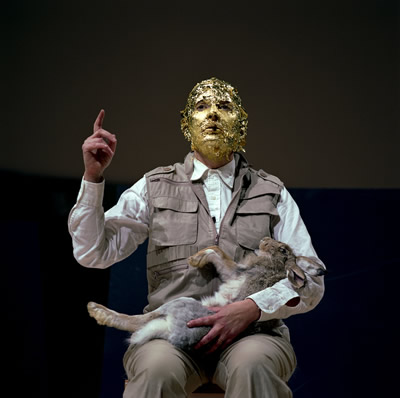
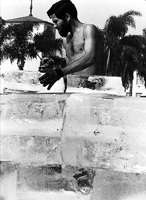
 ame ease of understanding in looking at Kaprow and his Happenings had I not tried so hard to wrap my head around Beuys first. But before thinking about that, let's talk about Happenings. What are they? They are something of a contradiction, aren't they? They are structured and controlled events that create a lack of control and foster a bit of chaos. How odd, right? So, a bunch of people get together with a plan, involve others in a sort of random event, all the while intending to deviate from the original plan and trying to summon some sort of mutual awkwardness. I know that sounds weird, but I think it is actually a pretty exciting notion. I think that part of the point of a Happening must be that you have to experience it to fuly comprehend it and gain from it, but what I do know is that it must be a pretty exhilirating thing. I mean that is what B.A. Baracas means when he says Hannibal is on the Jazz, isn't it? The thrill of not knowing what to expect, but knowing it is going to be a unique experience.
But I digress... After hearing about Kaprow, I first started wondering,how is a Happening different than a Fluxus piece? Okay, so first thing I thought of was actually the Pixies song (see below), which may or may not be related even though I don't think the lyrics really correlate to the art event, the verdict is not yet in for me. But then I thought about Fluxus and Happenings. They both have instructions and are reinterpreted. They both are performance-based art events that are pretty hard to define since they encompass so much.
Allan Kaprow. But then I started thinking about how people like Nam June Paik overlapped with Kaprow in events like the Originale, so maybe there isn't much of a difference. But then I started thinking, how are Kaprow's Happenings different than events like Tristan Tzara at Cabaret Voltaire? Was Kaprow just some kind of of Dada reincarnation? I guess in the end it doesn't really matter to me. What matters is that they have changed the way art is understood and experienced. Nam June Paik and his Cybernetics manifesto may not have initially changed much, but I think his influence is growing all the time and Kaprow involved and interacted with so many people during his lifetime that the impact of the Happening is probably immeasurable. I think that is why he seems so accessible today while someone like Beuys remains even more esoteric than Nam June Paik even though both are better understood than they used to be.
 It seems to me, that at the time Beuys was probably more understood than Kaprow, which is funny that it seems to be the opposite now. So, now I wonder are Happenings still possible? Are they dead with no hope of resuscitation? Should we still call them Happenings or maybe just Happened... I think what I have learned is that spontaneous, intuitive events are thrilling and that is why I try to add more improvisation to my artwork, probably why I fence, and definitely a big part of the way I make music. I would never want to be in a cover band. That is boring and stale (just like Kaprow thought art had become before he adopted the Happening). I would much rather have an impromptu jam even though many musicians never seem to agree with me (one amazing exception I have found is Billy Howerdel of A Perfect Circle, and Ashes Divide fame). This concept has definitely informed and reinforced some of the ideas for my project as I continue to lay down bass and guitar tracks and start filming. I find it much more effective to limit the amount of planning I do, so that I can improvise and collaborate more by taking advantage of the strengths that naturally occur and run with them. I am still mastering that art, but I think it will serve me well in this project and in others.
IHRTLUHC
JorSev