Showing posts with label philosophy. Show all posts

5.1.11

Warholworld


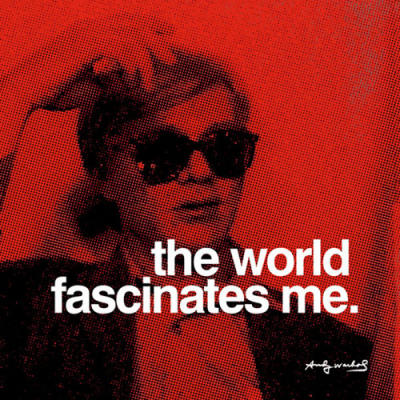
It seems to me that things in Andy Warhol's world are quite strange. Or at least most people think so, but I found that upon looking at him anew from several different sources recently, I can relate to a lot of his philosophy. Though his thinking comes off at times as quirky, insincere, or ambiguous, I could still relate to a lot of the content at the core of his ideas.
After watching the documentary made about Warhol by Ric Burns, I have some mixed feelings. The strange juxtaposition of sound textures, interviews, archival footage, rereading of Warhol quotes, praise for the artist, etc. seems to take Warhol a little bit out of context for me. Burns' work seems to me to glorify Warhol in an unnecessary fashion. It seems that a lot of the structure and direction of the documentary is orchestrated to make Warhol seem larger than life, but that seems a bit of a contradiction to me. Reading about Warhol and his quotations in the context of his life and even some of the information that I got from the film seem to tell me something different. Despite the ways Warhol seems intentionally misleading or comical, I find that his ideas of leftovers and art as business really make sense to me. I can relate to his feeling misplaced or trying to grapple with his fame. I don't think I could handle some of that attention and I don't like a maid cleaning up after me either. Anyway, a lot of these details reveal to me that Warhol was eccentric and famous, but also a regular person that got put into these positions and categories. I don't think he ever felt like some kind of absolute genius or one of the most influential artists of the 20th century any more than I or my classmates do. This image does not really fit with what many expect of a genius even though we may expect awkwardness and eccentricity to be a part of the formula. We have a lot of evidence to support that he was confused and lost more often than not, and even almost forgotten or ignored while he was still alive. While that does not prevent him from being a genius, it does seem to contradict some of the image that seems to have been constructed by the documentary or perhaps the Warhol foundation on a larger scale.

IHRTLUHC
Jordan Severson

7.3.10

The Radicant: the end, the beginning, or just another root?


Nicolas Bourriaud closes his book with a summation of concepts--being tied together? He addresses issues of appropriation, copy, and decisions. He makes an interesting point in that the fast-paced world of today continues to value time over space so that duplications are no big deal. people are borrowing and using shortcuts to produce, perhaps putting less effort into their own contributions expecting that someone else will borrow from them in turn. Is this the answer to the questions we have about the future of art? Does this provide us with what we came seeking when we picked up the Radicant? While all these concepts may prove thought provoking, I have to wonder if this is what is really happening. Have people really begun to abandon effort and craftsmanship for convenience and ease? I think some have, but I do not think that this is all we have to look forward to. Is Bourriaud guilty of these transgressions (perhaps innovations to him) himself? This book relies heavily on connections by nature, are all these references and thoughts something new, something old re-hashed to appear less lazy, or something different?

Monsieur Bourriaud, have I not been patient with you and your ideas? Why do you leave so many unanswered questions, hasty proclamations, and half-solutions? Why must you leave a bad taste in my mouth? Should a radicant ever really meet itself to become so entangled or neatly wrapped up and controlled by its own roots? Shouldn't it expand on into the infinite without the traditional closure of a book? If the author believes so adamantly in the future of art, the internet, mixed media, etc. and has such a great understanding of the direction in which these things will progress, why does he even bother with the obsolete format of a printed book? Why should he even publish his work? Why wasn't it composed and limited to exist solely on the internet, the vehicle of his radicant? Should I have obtained a Kindle and read this book through that lens to understand what I am missing? Why are he and his writing so obviously French and Franco-minded in a day when the ever-diverse radicant is drawing from whatever sources are of relative convenience, regardless of individual culture or perspective? Could not these views or exercises be demonstrated in a more complete way? How limited is the thought of one who extols limitless possibilities? How does one provide so little when one purports to have so many explanations?

Ok, N.B.
Good talk.


IHRTLUHC
Jordan Severson

p.s. Radicant, Altermodernism, Post-post, etc. would it be too much to ask that some better terminology be developed? Words need not be slaves to the concepts they describe.


27.2.10

Philosophy and the Radicant


The second part of Nicolas Bourriaud's The Radicant deals with altermodern concepts further with an increase in discussion of philosophy and and influential thinkers. It seems that this portion is less effective in introducing more concepts, but more concerned with elaborating the concepts already introduced to delve deeper into the meaning and relationships of the continuing conceptual themes.
Bourriaud starts to introduce examples, largely consisting of art work by Damien Hirst and Marceld Duchamp's readymades to point to how art has evolved to new places compared to what used to be acceptable on an intellectual level in the art world. This allows him to propose ways in which art might be changing in the present to become something new in the future and what sort of implications that the birth of web 2.o may hold for the future. Bourriaud discusses ideas of Walter Benjamin that were critical in the development of discourse surrounding topics like the results of image reproduction through mechanical means, which leads to the current question of what will happen to art once digital, and internet media so dominates our culture that those traditional means are all but forgotten. Benjamin argues in one of his most influential essays that an original image has an "aura" comprised of its unique, original existence, individual history and uncorrupted characteristics that cannot be observed by any form of reproduction. What will happen to such an "aura" on the internet? Can art made on a computer and existing only on the internet to begin with have some kind of "aura," or does it even really exist as an art object at all? Critics like Clement Greenberg pushed for art to be produced in its purest and most honest form, which was for him a reduction and emphasis on the use and demonstration of the most basic and essential tools of art. This led to works by the likes of Frank Stella, Barnett Newman, Mark Rothko, Helen Frankenthaler, and many others to create a form of art that best embodied this minimalist sort of intellectual art. What might be the result of such a direction of simplification or emphasis on basic elements when applied to internet and computer media? It seems that Bourriaud poses his earlier concepts and conjectures of the Radicant to answer these questions and predict the direction of his altermodern, but I am not so sure it is convincing.

IHRTLUHC
Jordan Severson